
Updated October 2026. Planning ranges only. Your actual price depends on your property, so always get written estimates from several contractors.
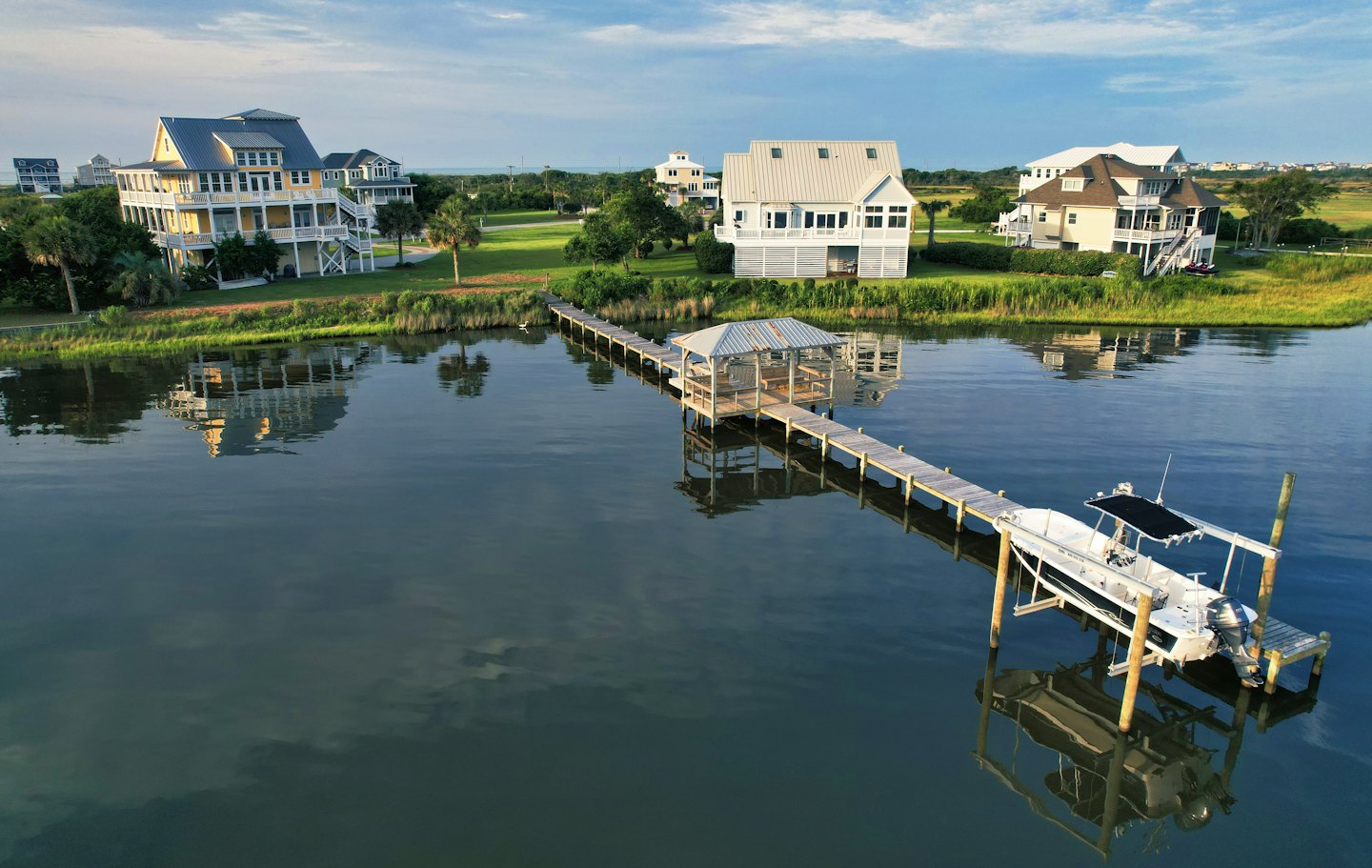
A dock or pier is one of the best upgrades a waterfront home can have, and one of the hardest to price without help. Here’s what typical projects cost in coastal Virginia, what drives the price, and what Virginia law says about building one.
The short answer
New fixed docks on pilings in coastal Virginia commonly run about $30 to $80 per square foot, depending on water depth, materials and site access. Floating docks typically run $20 to $45 per square foot.
Typical project totals
| Project | Typical range |
|---|---|
| Basic pier, short and in shallow water | $15,000–$25,000 |
| Standard dock, 40–80 ft with a small platform | $25,000–$45,000 |
| T-head or L-head dock | $40,000–$60,000 |
| Large deepwater dock with multiple slips | $60,000–$80,000+ |
| Floating dock, typical residential install | $10,000–$30,000 |
| Dock repairs | $200–$8,000+ |
What the pieces cost
- Pilings: about $500–$900 each for standard pressure-treated, $800–$1,500 for wrapped or deepwater pilings. Most residential docks use 8 to 20.
- Decking (replacement, per square foot): pressure-treated wood $15–$22, composite $25–$32, fiberglass-reinforced $28–$35, exotic hardwood $30–$40.
- Boat lift: roughly $3,000 for a personal watercraft lift up to $25,000+ for larger boats, plus $1,500–$4,000 for a canopy.
- Extras: electrical, water lines and lighting add cost and may need their own permits.
What drives the price
- Water depth. The farther you have to go to reach usable water, the longer the pier and the more pilings.
- The bottom. Mud, clay, sand or rock changes how pilings are driven.
- Materials. Composite and fiberglass decking cost more up front but last longer and need less upkeep than wood.
- Access. Work that has to be done from a barge costs more than work done from the yard.
- Design. T-heads, finger piers, roofs, lifts and utilities all add up.
Permits: Virginia’s simpler path for private piers
Virginia law lets waterfront owners build a private, noncommercial pier after submitting an application to the Virginia Marine Resources Commission (VMRC) for review, without going through the full permit process, as long as the pier stays within certain limits:
- The pier is no more than 6 feet wide, and finger piers no more than 5 feet wide.
- Any L-head or T-head platforms and floating docking platforms total no more than 400 square feet.
- The pier doesn’t extend past the navigation line and isn’t a hazard to boats.
- A boat lift is allowed, subject to local rules.
A full permit is required if you add an open-sided roof over a single boat or lift larger than 700 square feet, a shelter roof or gazebo larger than 400 square feet, or if a neighbor objects to a proposed roof.
Other approvals may still apply: the U.S. Army Corps of Engineers for work in navigable waters, your city’s wetlands board in some cases, and local rules on how far a pier can extend. Your property must also actually touch the water to carry the right to build a pier, so check your deed. Most marine contractors handle the paperwork, so ask about it when you request an estimate.
Questions to ask when you get estimates
- How long does the pier need to be to reach the depth my boat needs?
- How many pilings, what kind, and how deep will they be driven?
- What decking do you recommend, and what’s the price difference between wood and composite?
- Do you handle the VMRC application and any other permits, and is that included?
- What warranty do you offer, and are you licensed and insured in Virginia?
Sources
- Docks of the Bay: How Much Does a Dock Cost in Virginia? (2026)
- Local 2026 planning estimates for coastal Hampton Roads
- Code of Virginia § 28.2-1203 (private piers)
- Pender & Coward: How to Build a Pier in Virginia
757 Waterfront is a directory, not a contractor. This guide is general information for planning, not professional or legal advice.