
Dock and pier permits
Who approves a new dock, and how long it takes
Short answer: plan on some paperwork. Virginia law gives waterfront owners more room to build a private pier than most people expect, but almost every new dock, pier or boat lift in tidal water still goes through an application, and other approvals often apply. This guide explains who is involved and what to expect, so you are not surprised halfway through a project.
The short answer
- New private pier or dock: expect to file a Joint Permit Application, even if your pier ends up not needing a full state permit.
- Boat lift, boathouse or roof over a slip: expect an application. Roofed structures have size limits and get a closer look.
- Repairs in the same footprint: often simpler, but ask before you start. Replacing pilings or making a dock longer or wider is not the same as replacing boards.
- Local building permit: many cities and counties require one for piers and lifts, in addition to the waterfront approvals.
Who reviews a dock in Virginia
One form, the Joint Permit Application (JPA), goes to several agencies at once. Each looks at a different part of the project:
- Virginia Marine Resources Commission (VMRC): the state owns the bottom below mean low water, so VMRC reviews structures over that bottom. Virginia law lets riparian owners build many private, noncommercial piers without a full VMRC permit if they meet certain conditions, such as staying within navigation lines. VMRC uses your JPA to confirm whether your pier qualifies.
- U.S. Army Corps of Engineers, Norfolk District: reviews work in navigable waters. Many residential piers are covered by a general permit, which is usually quicker than an individual permit.
- Your local wetlands board: reviews work that affects tidal wetlands or dunes. A pier on pilings that lets the tide flow underneath often does not need a wetlands permit, but other work on the same project, such as a new walkway on fill, may.
- Your city or county: may require a building permit, and may have its own rules on how far a pier can extend and how close it can be to channels and property lines. Work near the shore can also fall under local Chesapeake Bay Preservation Act rules.
Does your pier qualify for the Army Corps fast track?
The Army Corps has a general permit for private piers, and most simple residential piers fit it. If yours meets every condition, you or your agent sign a self verification form and send it with the application. That signed form serves as the Corps approval, with no separate letter. The main conditions are:
- Private use only
- Reaches no more than one quarter of the way across the waterway, measured from high tide line to high tide line
- Over marsh, it stands on open pilings, no wider than 5 feet and at least 4 feet above the marsh
- No more than 2 boat lifts and 2 boat slips
- An open sided boat roof of no more than 700 square feet, or a pier roof or gazebo of no more than 400 square feet
- Non steel pilings no more than 12 inches across, with no more than 25 of them past the high tide line
- Outside underwater grass beds mapped by the Virginia Institute of Marine Science
- In fish spawning areas, no in water pile driving from February 15 through June 30 when the opposite shore is close by
If your pier misses any condition, it needs a written Corps approval instead, which takes longer. Either way, you still need any state and local approvals before you build. Your contractor or permit agent will know which path fits, but it helps to know the limits before you design a big pier head, a third lift or a large boathouse roof. After you file, see what happens next.
Your neighbors and your riparian area
A pier has to stay within your riparian area, the part of the water that goes with your shoreline. That area is not always a straight extension of your property lines, especially on curved shorelines and coves. Adjacent owners are usually notified about your application, and an objection can send the project to a public hearing. Talking with your neighbors before you apply can save time.
How long it takes
A simple residential pier with no objections often takes a few weeks to a couple of months from application to approval. Projects that affect wetlands, need a hearing, or draw objections take longer. Spring is the busiest season for applications, so applying in fall or winter can help if you want to build by summer.
What you need to apply
- A completed Joint Permit Application
- Drawings showing the pier, its size, its distance from property lines and the water depth
- Names and addresses of adjacent property owners
- Any fees required by VMRC or your locality
Most marine contractors prepare the drawings and file the application for you. Ask whether that is included in their price.
Why it matters
Building without the right approvals can mean fines, an order to remove the structure, and trouble when you sell the house, since buyers and lenders often ask about permits for waterfront structures. When in doubt, call your local wetlands board staff or VMRC before you build. Both will tell you whether your project needs an application.
Questions to ask your contractor
- Will you prepare and file the Joint Permit Application?
- Does my project need a local building permit, and who gets it?
- Are permit fees included in your estimate?
- How long do approvals usually take in my city or county right now?
- Can the dock be designed so it is simpler to approve, for example by keeping it on pilings over the marsh?
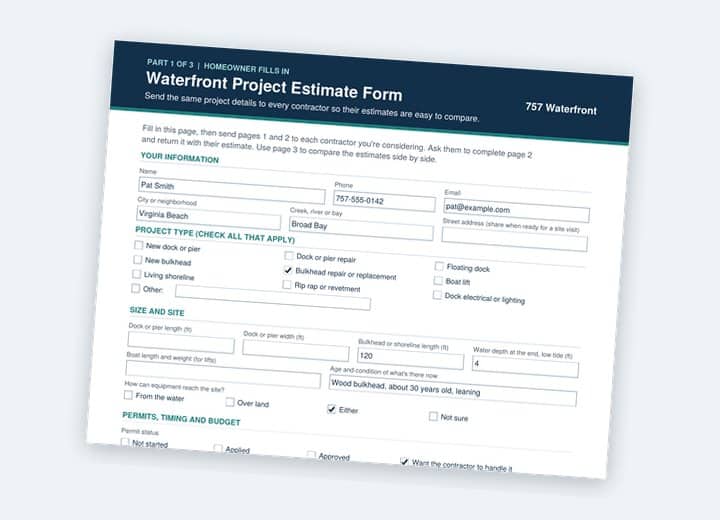
For the bigger picture, including bulkheads and shoreline work, see our guide to waterfront permits in Virginia. For prices, see what a dock or pier costs and boat lift costs and options. When you start collecting quotes, our free contractor estimate form asks every contractor about permits up front.
Free tool
Getting estimates?
Three estimates rarely quote the same job. Our free printable form gets every contractor to answer the same questions, including license, insurance, permits, price and warranty, so you can compare them side by side.
Find a contractor
By type of work: Docks and piers · Boat lifts · Floating docks
By area: See contractors by city
This guide is general information, not legal advice. Permit rules depend on your site and locality and can change, so confirm with VMRC, the Army Corps of Engineers and your local wetlands board before you build. Sources: Code of Virginia §§ 28.2-1203 and 28.2-1302; Virginia Marine Resources Commission; Wetlands Watch, Homeowner’s Guide; U.S. Army Corps of Engineers, Norfolk District, 23-SPGP-PASDO Category A self verification form for private piers. Last reviewed October 2026.