

Bulkhead upkeep
Catch the warning signs before your wall fails
Most bulkheads give plenty of warning before they fail, if you know what to look for. This guide covers how long each type of bulkhead usually lasts in Hampton Roads, the signs that a wall is wearing out, and simple habits that help it last longer.
How long a bulkhead lasts
| Material | Typical life in salt or brackish water |
|---|---|
| Pressure-treated wood | About 15 to 25 years |
| Vinyl sheet piling | 50 years or more for the vinyl, though the wood frame may need work sooner |
| Steel | About 25 to 50 years, depending on the coating |
| Concrete | About 30 to 50 years |
These are typical ranges, not promises. A well built wall in a quiet creek can beat them, and a poorly built wall on open water can fall short. If your home came with a bulkhead and you don’t know its age, a contractor can usually estimate it from the materials and hardware. For more on each material, see vinyl vs wood vs steel bulkheads.
Signs your bulkhead needs attention
Walk the wall at low tide, when more of it is showing, and look from both the yard and the water side if you can.
In the yard behind the wall
- Sinkholes or low spots. Soil is washing out through the wall. This is one of the most common early warnings.
- Cracks in the lawn running parallel to the wall, or a patio or walkway that is settling toward the water.
- Standing water behind the wall after rain, which can mean drainage holes are clogged.
On the wall itself
- Bowing or leaning. Sheets or boards pushing out toward the water, or a top cap that leans forward, often mean the tiebacks behind the wall have failed.
- Gaps between boards or panels, or soil and sand leaking out at low tide.
- Soft, split or rotting wood, especially at the waterline and on the pilings.
- Small holes in wood below the waterline, a sign of marine borers.
- Cracked or split vinyl panels, or panels separating at the joints.
- Rusted, bent or missing bolts and tie rods. Rust streaks running down the face of the wall are a clue.
- Cracks or crumbling in a concrete wall or cap.
At the base of the wall
- Scour, meaning the bottom in front of the wall is washing away and exposing more of the sheeting than before. A wall that loses support at its base can kick out at the bottom.
Call a contractor soon if you see
- A section of wall that has visibly moved or is leaning more than before
- A sinkhole that keeps coming back after you fill it
- A gap large enough to see water or daylight through
- New damage after a storm or very high tide
Keep people, vehicles and heavy equipment away from a wall that is moving. After a storm, our storm damage guide covers what to check first.
What shortens a bulkhead’s life
- Waves and boat wakes, especially on open water or busy channels.
- Storms and storm tides, which can overtop the wall and wash soil out from behind it.
- Poor drainage. Water trapped behind the wall pushes on it. Weep holes and filter fabric let water out while keeping soil in.
- Heavy weight near the edge, such as parked vehicles, sheds, large planters or equipment.
- The original build, including how deep the sheeting goes, the tiebacks, and the hardware used.
How to help it last longer
- Look it over twice a year and after every big storm. Take photos from the same spots each time so you can spot changes.
- Keep weep holes clear of mud, grass and debris.
- Don’t just fill sinkholes. Filling one hides the problem. Find out where the soil is going.
- Keep heavy loads back from the edge of the wall.
- Fix small problems early. Replacing a few boards or bolts now costs far less than a new wall later.
- Ask about stone at the base if scour is a problem. Rip rap at the toe of the wall can protect it, but it usually needs a permit.
Repair or replace?
Many problems can be repaired if they are caught early. A common rule of thumb: if repairs would cost 60 to 70 percent or more of a full replacement, replacing usually makes more sense. When you replace, it may also be worth asking whether a living shoreline or hybrid would work on your property, since Virginia prefers them where they are suitable. Our bulkhead cost guide covers typical prices for both repairs and replacement.
Even repairs can need a permit, depending on the work. Most contractors know what your project needs and handle the paperwork. See our permits guide for the basics.
Free tool
Getting estimates?
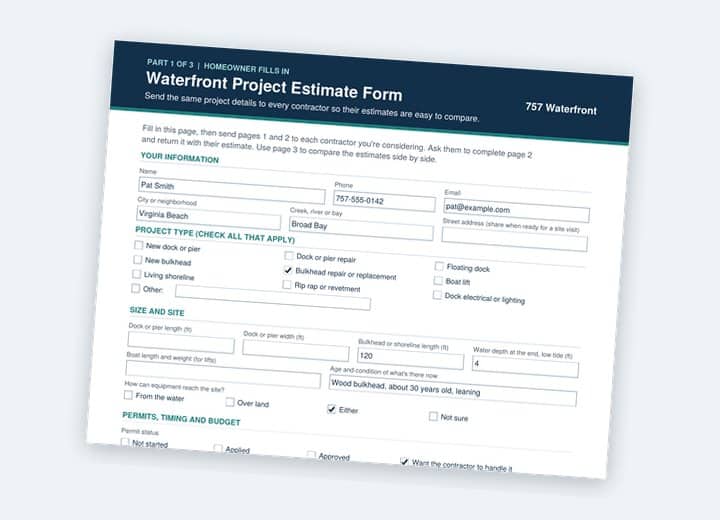
Three estimates rarely quote the same job. Our free printable form gets every contractor to answer the same questions, including license, insurance, permits, price and warranty, so you can compare them side by side.
Find a contractor
By type of work: Bulkheads and seawalls · Rip rap and shoreline · Living shorelines
By area: See contractors by city
This guide is general information, not engineering advice. A wall that is moving or failing should be looked at by a licensed contractor or engineer. Lifespans are typical ranges and depend on construction quality and site conditions. Last reviewed October 2026.