
Buying & selling
What to do about the pier before you list
Deciding what to do with your pier before selling? Buyers ask about the pier early. Maybe you don’t have one, maybe yours has seen better days, or maybe you’re wondering whether to take it out. Here’s what each choice involves, so you can decide before you list.
Which one are you?
No pier
Should I build one?
Usually a hard call when you’re selling soon. Showing buyers a pier is possible may matter more.
Old or damaged
Repair it or price it in?
Repairs in the same footprint are simpler. Know the condition before a buyer’s inspector finds it.
Thinking of removing it
Should I tear it down?
Ask the state first. We found nothing showing that removing a pier helps a sale.
If you don’t have a pier
Does a pier add value? It can. Zillow’s 2026 report on home features, based on homes listed for sale in 2025, found that homes with a dock sold for 5.4% more than expected. That is a national figure, not one for Virginia tidal water. Research on lake properties has also found that buyers pay more for lots where a dock can be built, which suggests the possibility of a pier matters, not just the pier itself.
Why building one to sell is a hard call:
- Timing. A new pier means a permit review and a spot on a contractor’s schedule. If you’re selling soon, it may not be done in time.
- The math. A higher sale price only helps if it’s more than what the pier costs you. See what a dock or pier costs.
- Buyers have their own plans. Many would rather design a pier around their own boat.
What may make more sense: show buyers a pier is possible.
- Water depth. Buyers with boats want to know there’s enough water at the end of a pier.
- The rules. Virginia law allows many private, noncommercial piers built by the waterfront owner, after an application is submitted to the Virginia Marine Resources Commission (VMRC) for review. There are limits, such as a maximum width of six feet. Our dock permit guide explains more.
- An expert’s opinion. A note from a permit agent or contractor saying a pier looks feasible gives buyers something concrete.
If you have a permit for a pier you haven’t built: permits come with a completion deadline. A sample VMRC permit we reviewed says it can’t be transferred without the Commissioner’s written consent, and local wetlands board permits often say the same. The Army Corps of Engineers permit form asks the new owner to sign it to make the transfer valid. Ask each agency before you count on a permit going to your buyer.
If your pier is old or damaged
Repair or replace it in the same footprint. Under Virginia law, maintaining or replacing a previously authorized pier doesn’t need a new VMRC permit, as long as it’s rebuilt within the footprint of the existing pier. The Army Corps covers repair of previously authorized structures that are still serviceable, and storm damage repairs if the work starts within two years. Going bigger or changing the layout is new work and needs a new application. If a storm did the damage, see after a storm.
Or price it in. Some sellers leave the pier as it is and get a contractor’s assessment so buyers know what they’re facing. Agents in Maryland report that a pier problem found during the buyer’s inspection tends to turn into a big negotiation, because marine work is specialized and slow to permit. Knowing the condition before you list puts you in control of that conversation.
Should you tear it down?
- Ask before you pull pilings. We found no clear state exemption for removing a pier. The Army Corps does cover removing previously authorized structures. Contact VMRC before any work in the water.
- A pier in bad shape is still your responsibility. VMRC can require an owner to repair or remove a pier that’s abandoned or in such disrepair that it’s a hazard.
- No evidence that removal helps. We found no study or data showing that taking out an old pier raises a sale price.
Before you list: pull your permit history
A pier built without the required approvals can be a problem for you and for your buyer. Virginia has an after the fact application process, and fees and penalties can apply. Buyers can be held responsible for an unpermitted pier they inherit, which is why careful buyers ask. VMRC, the Army Corps and your local wetlands board keep records, and a permit agent can help you find them.
What Virginia requires you to tell buyers
Virginia’s Residential Property Disclosure Act is largely “buyer beware,” and its required disclosures don’t name piers or pier permits. Sellers still can’t misrepresent the property. If you’re unsure what to say, talk with your real estate agent or a lawyer.
If you’re the buyer
- Ask whether the pier was permitted, and ask for the paperwork.
- Ask whether any unbuilt permits will transfer, and when they expire.
- Have the pier inspected along with the house.
- Confirm that the riparian rights, the right to build a pier, come with the property.
Our buyer’s checklist and seller’s checklist cover the rest of the property.
Free tool
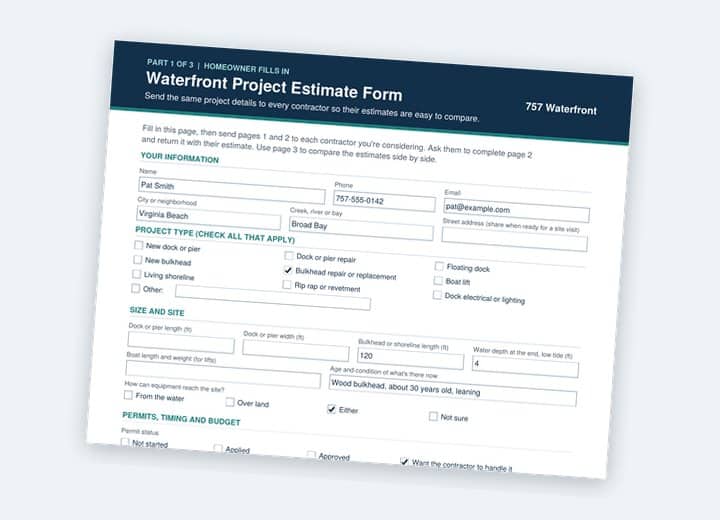
Getting estimates?
Three estimates rarely quote the same job. Our free printable form gets every contractor to answer the same questions, including license, insurance, permits, price and warranty, so you can compare them side by side.
Find help
Permits, feasibility and records: Find a permit agent
Inspection, repair or a new pier: Docks and piers · See contractors by city
This guide is general information, not legal or real estate advice. Rules depend on your site and locality and can change, so confirm with VMRC, the Army Corps of Engineers and your local wetlands board before any work. Sources: Code of Virginia §§ 28.2-1203, 28.2-1210 and 28.2-1213; VMRC Subaqueous Guidelines; a sample VMRC permit (2022); U.S. Army Corps of Engineers permit form (33 CFR Part 325, Appendix A) and 2026 Nationwide Permit 3; Virginia Residential Property Disclosure Act (Code of Virginia § 55.1-700 and following); Zillow Research, home features report (2026); a study of South Carolina lake property sales (2016); Maryland real estate agents’ published guidance. Last reviewed November 2026.